A Pocket Field Note for a Rainy Afternoon
A rainy afternoon field note helps you notice changing reflections, sounds, and small details from a dry, sheltered spot without rushing the scene.
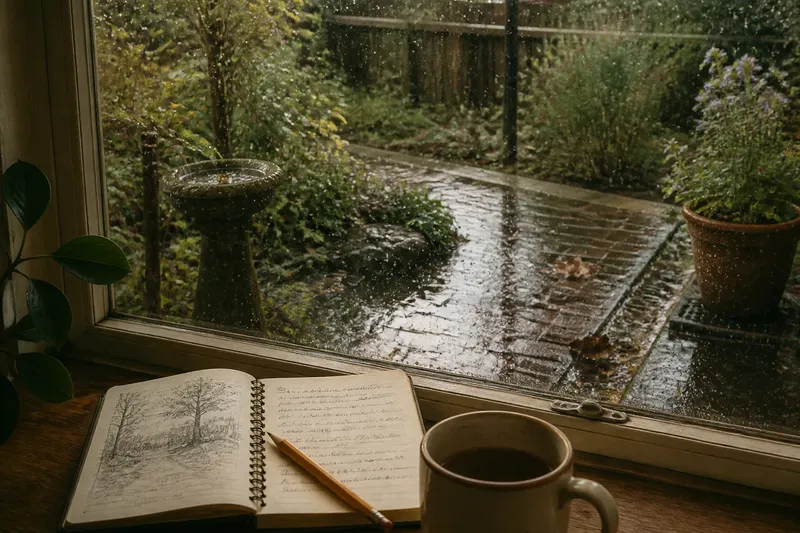
What can you notice about rain without stepping into it? A rainy afternoon field note turns a window, covered porch, or sheltered doorway into a small observation post, where reflections, sounds, and tiny changes come into view at their own pace.
Bring a notebook and pencil, or use a notes app if the spot is dry and your device stays protected. Choose one view you can observe comfortably. You are not trying to explain the whole storm; you are keeping a clear record of what changes in a small patch of the world.
Choose a view that stays safe and steady
Look from indoors or beneath a secure roof, well back from traffic, standing water, and exposed edges. A kitchen window facing a garden, a porch looking onto a sidewalk, or a covered bus shelter with a clear view can all work. Keep your attention on what is visible from where you are, rather than moving closer for a better look.
Pick a few landmarks to anchor the scene: the corner of a window frame, a fence post, a planter, a paving joint, or the rim of a birdbath. These fixed points make change easier to describe. A field note is a little like a bookmark: it lets you return to the same place in the scene and see what has shifted.
Before writing, jot down the time in ordinary terms, such as “early afternoon,” and note your shelter and viewpoint. Add a simple sketch if the scene is hard to describe. It need not be neat; a few lines showing a drain, a curb, and a puddle can preserve where each detail appeared.
Watch reflections change their edges
Start with one reflective surface: a windowpane, a shallow puddle, a wet car roof, or a dark paving stone. Write down what it reflects before trying to interpret it. You might see a pale patch of sky, a roofline, or a blurred tree shape.
Then watch the reflected image for a short interval. Do raindrops make rings, scattered dimples, or a shifting blur? Does the reflection break apart when drops strike, then gather again between them? Describe the visible action rather than deciding what it “means.”
Compare two surfaces if they are both in view. Glass may hold a recognizable shape while rough pavement scatters it into patches; a puddle may show a crisp outline in one corner and a wavering one where drops land. Record the difference in surface and appearance together, so a later reader can follow your observation.
Say you are watching from a dry kitchen window and notice a puddle beside a brick path. At first, the puddle reflects a strip of bright sky; as rain taps its surface, the strip breaks into rings and reappears between them. A useful note might read: “Sky strip visible near the left edge; each drop interrupts it, then the pale shape reforms.” That describes a change without claiming to know what is happening below the water.
Listen for layers rather than one rain sound
Rain rarely sounds like a single, even hush. From shelter, listen for separate places where it lands: leaves, a gutter, a window ledge, a metal railing, or pavement. Note which sound is sharp, soft, hollow, or steady, and whether one becomes easier to hear when another fades.
Try a brief listening pause with your eyes still on the same view. Write down the sounds in the order you notice them, not in the order you think they should occur. “Soft patter on leaves; hollow ticks from the sill; one heavier splash near the curb” gives a reader more to imagine than “rain is loud.”
Pay attention to changes in rhythm. The tapping may thicken, thin out, or shift when wind carries drops against a different surface. If you cannot tell whether a sound is rain or something else, record the uncertainty plainly: “A low, intermittent rumble behind the patter.” An open question is better field-note material than a confident guess.
Find small changes at ground level
Once you have watched reflections and listened, scan the visible ground for one small detail. Look for a leaf turning over, a darkening patch on a wall, a drop hanging from a twig, or the path a thin stream takes around a stone. Keep the search close to your chosen view instead of trying to catalogue everything.
Describe a detail by its position and condition. “A curled brown leaf rests beside the drain, its tip lifting when drops strike nearby” is specific enough to revisit. If the leaf moves, note where it ends up; if it stays put, that is also an observation.
Notice boundaries: where dry pavement meets wet pavement, where water collects, or where a wall remains sheltered. These edges often make change easier to see than the middle of a surface. You might mark the boundary in a sketch and return to it after listening or watching another reflection.
Keep a rainy afternoon field note useful
A short entry can hold the scene without turning it into a report. Include the viewpoint, a few sensory details, and one change you observed. Leave space for a question or a later note if you want to return to the same window on another rainy day.
- Viewpoint: Name the sheltered place and the direction you are looking.
- Conditions: Describe the rain as it appears and sounds, without forcing a technical label.
- Reflection: Record the surface, the reflected shape, and what interrupts or alters it.
- Sound: Separate the sources you can distinguish and note any uncertain ones as uncertain.
- Small detail: Locate one visible change with a nearby landmark.
- Open question: Write down something you would like to check if the scene changes again.
Keep the language plain. “The stone looks darker now” is a clear comparison if you have seen it before; “the stone is absorbing water” goes beyond what the view alone can establish. You can save that explanation as a question rather than making it the record.
What should you write down first?
How long should a rainy afternoon field note take?
There is no required duration. Spend enough time to notice one change, then stop while the view still feels interesting; you can always return later if you remain sheltered and comfortable.
What if the rain does not change while I watch?
Record what stays steady: a repeated tapping sound, a reflection that remains broken, or a leaf that does not move. A note about continuity gives you a useful point of comparison for another observation.
Can I use my phone instead of a notebook?
Yes, if it can remain dry and you can use it without leaning out or leaving shelter. A quick text note or voice memo can capture wording, while a paper sketch may be easier when several objects need to be placed in relation to one another.
How can I tell observation from interpretation?
Observation describes what you can see or hear; interpretation offers a possible reason. Keep the two separate by writing the visible detail first and adding a question mark or “perhaps” before any explanation you are unsure about.
Return to the same view with fresh eyes
Before closing the notebook, add one detail you might otherwise forget: the position of the brightest reflection, the surface making the clearest sound, or the landmark beside a small stream of water. If you revisit the scene, use the same viewpoint where possible and note what differs rather than trying to make the entries match.
A rainy afternoon field note does not need a dramatic discovery. A broken reflection, a new rhythm on the sill, and a leaf nudged against the drain are enough to make one sheltered view more legible. Keep your record close to what you actually noticed, and let the unanswered question wait for the next quiet look.