Leaf Veins and River Networks: A Week of Close Looking
Compare leaf veins and river networks through a week of close looking, and learn to spot shared shapes, meaningful differences, and useful questions.
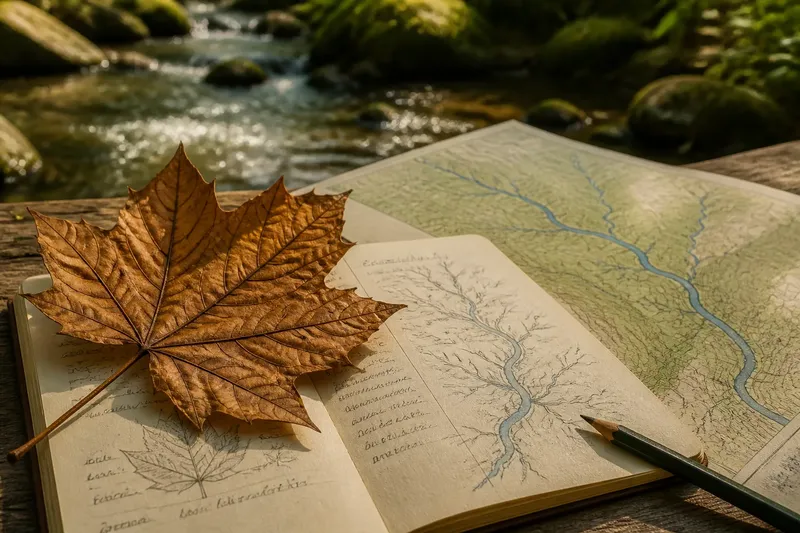
What can you learn by comparing leaf veins and river networks? Start with a fallen leaf and a clear river map: their branching lines offer a visual puzzle, but the differences between a plant and a watershed are just as revealing.
Rather than tracking the same resemblance day after day, give each session a distinct question. You might examine how lines meet, where networks end, or what a map leaves out. A map and a leaf are a little like two different kinds of road atlas: both show routes, but each represents a different place and purpose.
Choose a leaf and a map that show useful detail
Pick an intact fallen leaf with visible veins. A broad leaf from a maple or oak can make it easier to follow a main vein and smaller lines, but you do not need to identify the tree.
For the river network, choose a topographic map or public map that shows tributaries clearly. A map that leaves out small streams can still be useful; just treat it as a selected view, not a complete record of every channel.
Keep a notebook and pencil handy. Make a simple two-column page labeled “leaf” and “river,” and use brief notes or quick sketches to capture what you see.
Use each day to investigate a different feature
- Day one, trace a route: Follow the leaf’s main vein from stem toward tip, then trace a main river on the map. Note where each line bends or stops; if a map edge cuts off the channel, mark it as beyond the view rather than as a natural endpoint.
- Day two, examine junctions: Find places where smaller lines meet larger ones. If the junction is clear, sketch its shape; if damage or map detail makes it hard to see, mark it uncertain instead of guessing.
- Day three, compare spacing: Look at one part of the leaf and one part of the map. If one area appears crowded with branches and another more open, record that contrast; do not treat the two views as equal-sized physical samples.
- Day four, follow boundaries: Trace several leaf veins toward the blade’s edge and several channels toward the map border. If a line reaches the leaf margin, note that boundary; if it reaches the map edge, check for context before deciding whether it continues beyond the frame.
- Day five, look for cross-connections: Check whether fine lines connect with neighboring lines. If you can see a connection, sketch it; if the image is too faint or crowded, leave the relationship unresolved.
- Day six, note what the view hides: Look for missing or obscured detail, such as a damaged section of leaf or streams omitted from the map. If a feature cannot be seen, record it as unavailable rather than filling it in from expectation.
- Day seven, write a comparison: Choose one visible similarity and one clear difference. If both are supported by your notes, include them; if a sentence explains why the patterns formed, set it aside unless you have evidence beyond appearance.
Keep the comparison focused on visible features
The strongest comparison is specific: both views may show smaller lines connected to larger ones, while the leaf’s network stays within a blade and the river channels cross a mapped landscape. That description gives the reader something concrete without implying that the systems work alike.
Map scale and line choices matter. A map may omit a small stream, while a leaf can be turned under the light or viewed more closely. Those differences affect what you can see, so describe the materials in front of you rather than treating their lines as matching measurements.
Say you have a fallen leaf with a bold central vein and a map showing a main river with several tributaries. You trace the vein toward the tip, sketch two smaller branches, then trace three tributaries into the main channel. Your notes support the sentence, “Both views show smaller routes joining a prominent line, but the leaf network fits within the blade while the mapped channels spread across the landscape.” The observable result is a comparison of shape and setting, not an explanation of how either network formed.
Ask what the patterns leave unanswered
Seeing a branching shape does not explain its cause. To investigate how veins develop in a particular plant, you would need botanical information about that plant; explaining a river network calls for information about its landscape and water flow.
For now, keep the notebook divided between observations and questions. “Several fine veins meet the main vein” belongs in the observation column; “What conditions shaped this network?” is a question for further investigation.
What do readers often ask about leaf veins and river networks?
Are leaf veins and river networks the same kind of pattern?
They can share a visible arrangement of larger lines connected to smaller ones, but they are different systems. Comparing their shapes does not make their structures or formation interchangeable.
Why do maps leave out some streams?
A map selects and simplifies details to suit its purpose and scale. Treat the channels shown as a representation, and avoid assuming that every small watercourse appears.
What leaf is easiest to examine?
Choose an intact fallen leaf with veins visible in ordinary light. A broad blade can be easier to handle and follow, but the exercise does not depend on knowing its species.
What should I write if a line disappears?
Describe what you can establish: it may reach an edge, fade from view, or be obscured. If the evidence does not distinguish those possibilities, mark the endpoint uncertain rather than choosing one.
Make the final note useful to another observer
Write a short account that names the leaf and map view you used, describes one shared feature, and gives one difference. Add any uncertainty that affects the comparison, such as a map border or a damaged leaf.
A careful note can still lead to a bigger question. The phrase “leaf veins and river networks” gives you a starting point for noticing structure; your next useful move is to seek evidence suited to the explanation you want, rather than asking appearance to supply an answer it cannot provide.