How Sun Angle Changes a Shadow’s Shape
Learn how sun angle changes a shadow’s shape by tracking one still object and separating shifts in direction and length from changes in its outline.
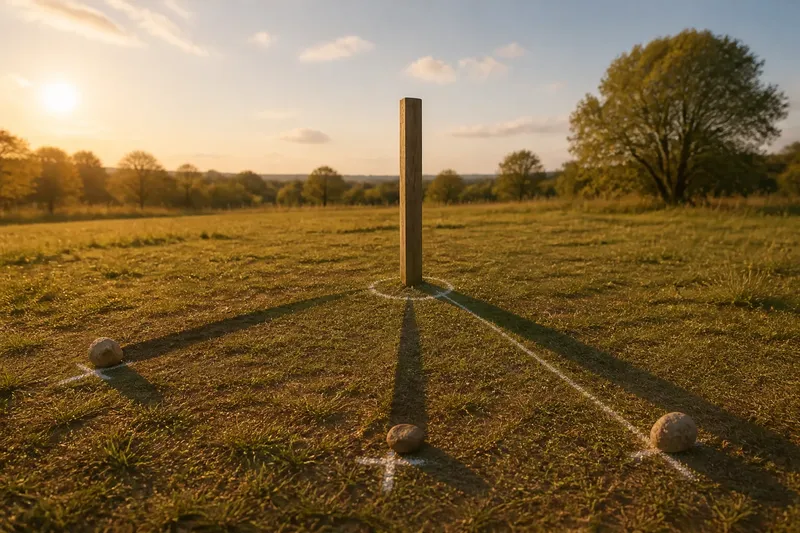
Why does the same fence post cast a long shadow in the morning and a shorter one near midday? How sun angle changes a shadow’s shape comes down to the direction of the light, the object’s outline, and the way that outline is projected onto the ground.
Imagine a straight garden stake standing on a flat patch of ground. You stay in one place and watch it through a clear day; the stake remains still, but its shadow shifts across the ground and changes its proportions.
Sun direction shifts the shadow across the ground
When the sun is low in the eastern sky, its light reaches the stake from the east, and the shadow falls generally west. The low angle sends the shadow farther from the stake’s base. As the sun appears to move higher, the shadow shortens; later, with the sun toward the west, it extends generally east.
This is projection: the stake blocks light, and the ground receives the resulting dark shape. A flashlight and a toy make the geometry easy to picture. Shine the flashlight across a tabletop and the toy’s shadow stretches; aim it more steeply downward and the shadow gathers closer to the toy.
To compare observations fairly, keep the stake and your viewing spot fixed. Mark the stake’s base with chalk, then note the shadow’s direction and where its tip falls. The mark lets you tell a change in the projection from a change caused by moving the object or observer.
Object shape and light direction determine the outline
A shadow is not a flat copy of an object. Its outline depends on which parts block light along the path from the sun to the ground, as well as the object’s shape and the direction of the incoming light.
For a stationary upright stake, its shaft does not turn to present a different face to the sun. Instead, the sun’s changing direction alters how the stake’s width and any surface features project onto the ground. A narrow shaft can cast a broader-looking patch when its width projects across the shadow’s direction; when that width projects mostly along the shadow, the band can look slimmer.
Suppose the imagined stake has a small stub sticking out to one side. From one sun direction, the stub’s shadow may form a visible hook beside the shaft’s shadow. As the light direction shifts, the hook’s projection moves relative to the main shape and may line up with it, becoming harder to distinguish.
The sun’s elevation mainly changes how far the shadow reaches, while the sun’s direction around the stake affects where the shadow falls and how the object’s outline is projected. These are related parts of the same geometry, but they do not mean the stake itself has changed orientation.
Clear and cloudy skies make different edges
Under a clear sky, direct sunlight comes predominantly from the sun’s direction, so the boundary between light and shade is often distinct. With clouds, light arrives from a broader area of the sky, softening that boundary.
A soft edge can make small details harder to read, even when the shadow’s general direction is still visible. If the outline looks blurred, note the sky conditions rather than treating every faint edge as a change in the object’s projected shape.
What questions help read a changing shadow?
Why does a shadow point away from the sun?
The object blocks light traveling toward the ground, so the darkest region forms on the side opposite the sun. Its direction is generally away from the sun’s apparent position.
Why is a shadow longer when the sun is low?
Low-angle light travels across the ground at a shallow angle, so the blocked region reaches farther from the object. When the sun is higher, the light descends more steeply and the shadow falls closer to the base.
Can a shadow change shape while the object stays still?
Yes. The sun’s changing direction alters how the object’s features project onto the ground. A stub, uneven edge, or other small detail may shift position in the shadow or merge with its main outline.
Why does a shadow look blurry on a cloudy day?
Clouds spread sunlight across more directions, creating overlapping areas of light and shade. That softens the boundary compared with a shadow formed in direct sunlight.
A simple observation separates length from outline
Imagine you record the stake’s shadow at three moments: morning, near the sun’s highest point, and later in the day. At each moment, you mark the tip with chalk and sketch the outline from the same viewing place. The expected result is a long westward shadow in the morning, a shorter one near midday, and a longer eastward shadow later; the stub’s projected hook may also shift or blend into the shaft’s shadow.
In this imagined observation, the marks answer two different questions. The distance from the base to each tip shows how shadow length changes, while the sketches show how the outline changes with the sun’s direction. If clouds soften an edge, the record can distinguish an unclear boundary from a definite change in shape.
When you look up how sun angle changes a shadow’s shape, keep those observations separate: track the tip for direction and length, then examine the outline for projected details. It is like watching a paper cutout shift across a page—the cutout stays put, but the light changes the shape that lands beside it.
That distinction is useful whenever a familiar object seems to cast a new shape. A shadow records both the object’s outline and the direction of the light, but the ground shows them together; a quick mark at the base helps you read each part more clearly.